
Global Heat Pump Market to Reach USD 167.4 Billion by 2036 as Electrified Heating Becomes the Global Standard
Policy-Driven Electrification, Efficiency Mandates, and Smart HVAC Integration Redefine Global Heating Infrastructure
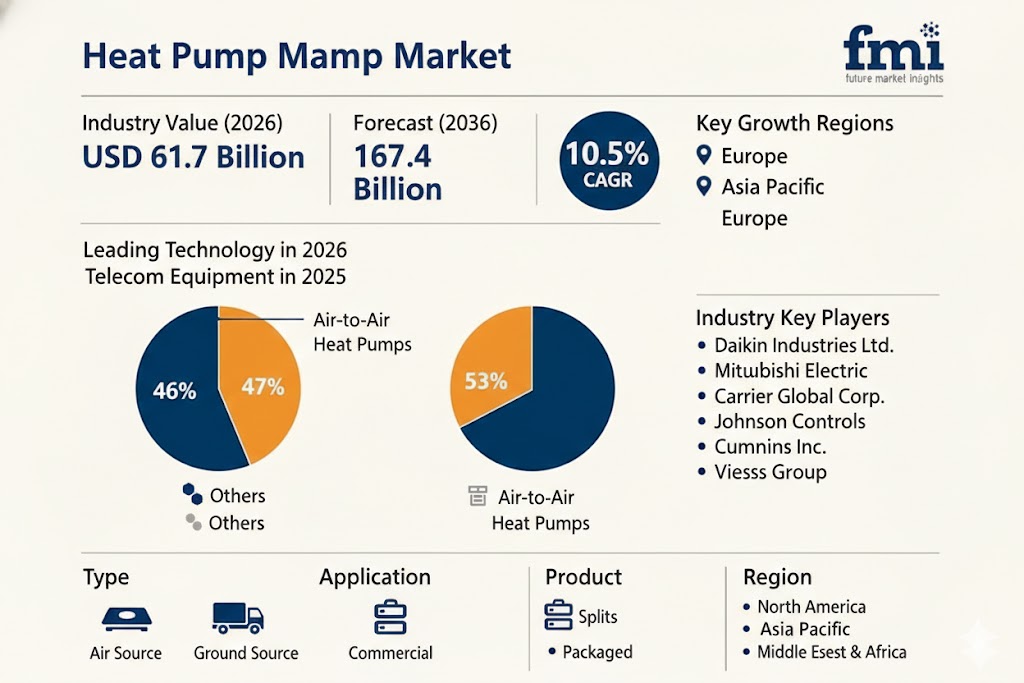
NEWARK, DE / ACCESS Newswire / February 6, 2026 / The global transition toward low-carbon buildings is structurally reshaping heating and cooling markets. According to Future Market Insights (FMI), the heat pump market, valued at USD 61.7 billion in 2026, is forecast to reach USD 167.4 billion by 2036, expanding at a 10.5% CAGR. Growth is underpinned by electrification mandates, energy-efficiency regulations, and accelerating replacement of fossil-fuel heating systems.
Electrification Policies and Energy Economics Drive Structural Demand
Heat pump adoption is being driven less by voluntary efficiency upgrades and more by binding policy frameworks targeting building emissions. Governments across Europe, North America, and Asia-Pacific are actively discouraging gas and oil heating through installation bans, carbon pricing, and financial incentives. These policies are aligning with rising fuel costs, making electric heating increasingly attractive from both compliance and operating-cost perspectives.
Key demand accelerators include:
National building electrification mandates
Utility rebates and tax credits reducing upfront costs
Rising natural gas and heating oil price volatility
Long-term emissions compliance requirements
Technology Advancements Expand Viability Across Climates
Modern heat pumps are overcoming historical performance limitations through significant engineering improvements. Inverter-driven compressors, enhanced heat exchangers, and intelligent control systems are improving seasonal efficiency and enabling stable operation under variable load conditions. Cold-climate system advancements are particularly critical, unlocking demand in regions previously dominated by combustion-based heating technologies.
Technology trends supporting growth:
Variable-speed compressor adoption
Improved low-temperature heating capacity
Advanced system controls and diagnostics
Higher seasonal performance ratings (SCOP/SEER)
Refrigerant Transition Reshapes Procurement Decisions
Environmental regulation is increasingly influencing heat pump purchasing criteria. Natural refrigerant systems account for 22.7% of market share in 2026, reflecting growing adoption of low-GWP alternatives such as propane (R290) and CO2. Buyers are prioritizing refrigerant compliance not only for sustainability goals, but also to future-proof assets against tightening regulatory restrictions.
Refrigerant-driven market shifts include:
Compliance with F-Gas and global GWP regulations
Increased adoption of R290 and CO2 systems
Preference for long-term regulatory certainty
Alignment with green financing requirements
Heat Pump Market Outlook (2026-2036)
Metric | Details |
|---|---|
Market Value (2026) | USD 61.7 Billion |
Forecast Value (2036) | USD 167.4 Billion |
Growth Rate (CAGR) | 10.5% |
Leading Technology | Air-to-Air Heat Pumps |
Primary Drivers | Electrification, efficiency mandates, and fuel cost volatility |
Market Segmentation Highlights Concentrated Demand Areas
Air-to-air heat pumps dominate the technology landscape, holding 46.1% share in 2026, supported by installation flexibility and retrofit suitability. Residential applications represent 55.3% of total market value, reflecting strong replacement demand for aging boilers and furnaces. Residential systems benefit from faster payback periods and clearer cost-saving narratives compared to commercial installations.
Dominant market segments:
Air-to-air heat pumps: 46.1% share
Residential end use: 55.3% share
Retrofit installations as primary volume driver
Growing demand for ductless configurations
Regional Growth Patterns Reflect Policy Intensity
Heat pump adoption varies significantly by country, shaped by regulatory ambition, climate conditions, and housing stock maturity. European markets lead due to strict decarbonization mandates, while Asia-Pacific shows rapid acceleration driven by urbanization and domestic manufacturing expansion. North America continues to benefit from incentives tied to electrification and smart-home integration.
Country-level growth outlook (2026-2036):
Germany: 12.1% CAGR
Japan: 11.8% CAGR
France: 10.9% CAGR
Canada: 10.6% CAGR
United States: 10.2% CAGR
Competitive Landscape Shifts Toward Integrated Energy Solutions
Competition in the heat pump industry is increasingly defined by system integration rather than hardware efficiency alone. Leading manufacturers are investing in modular platforms, smart-building compatibility, and service infrastructure. Integration with renewable energy systems and building automation is becoming a decisive factor in large-scale procurement and specification decisions.
Key competitive strategies include:
Modular and scalable product platforms
Smart building and IoT compatibility
Installer training and service networks
Partnerships with renewable energy providers
Market Outlook: Heat Pumps Emerge as Core Building Infrastructure
By 2036, heat pumps are expected to shift from alternative heating solutions to default building infrastructure. As electrification, grid interactivity, and emissions accountability become central to building design, heat pumps will play a foundational role in delivering cost-efficient, compliant, and low-carbon thermal comfort across residential and light commercial sectors.
Looking Ahead: Heat Pumps as Enablers of Digital Inclusion
As buildings become digitally connected assets, heat pumps are emerging as gateways to broader digital inclusion within energy systems. Smart heat pumps equipped with sensors, cloud connectivity, and predictive controls enable participation in demand-response programs, real-time energy pricing, and grid optimization platforms. This connectivity empowers households and small businesses to actively manage energy costs, access digital utility services, and benefit from intelligent, data-driven energy infrastructure-bridging the gap between electrification and inclusive digital energy participation.
For an in-depth analysis of evolving formulation trends and to access the complete strategic outlook for the Heat Pump Market through 2036, Full Report Request: https://www.futuremarketinsights.com/reports/heat-pumps-market
Related Reports:
Heat Pump Compressors Market- https://www.futuremarketinsights.com/reports/heat-pump-compressors-market
Rotary Heat Pump Compressors Market- https://www.futuremarketinsights.com/reports/rotary-heat-pump-compressors-market
Ducted Heat Pump Market- https://www.futuremarketinsights.com/reports/ducted-heat-pump-market
Hydronic Heat Pump Market- https://www.futuremarketinsights.com/reports/hydronic-heat-pump-market
About Future Market Insights (FMI)
Future Market Insights (FMI) is a leading provider of market intelligence and consulting services, serving clients in over 150 countries. Headquartered in Delaware, USA, with a global delivery center in India and offices in the UK and UAE, FMI delivers actionable insights to businesses across industries including automotive, technology, consumer products, manufacturing, energy, and chemicals.
An ESOMAR-certified research organization, FMI provides custom and syndicated market reports and consulting services, supporting both Fortune 1,000 companies and SMEs. Its team of 300+ experienced analysts ensures credible, data-driven insights to help clients navigate global markets and identify growth opportunities.
For Press & Corporate Inquiries
Rahul Singh
AVP - Marketing and Growth Strategy
Future Market Insights, Inc.
+91 8600020075
For Sales - [email protected]
For Media - [email protected]
For web - https://www.futuremarketinsights.com/
SOURCE: Future Market Insights, Inc.
Information contained on this page is provided by an independent third-party content provider. XPRMedia and this Site make no warranties or representations in connection therewith. If you are affiliated with this page and would like it removed please contact [email protected]
